
A Chain Needs an Exit
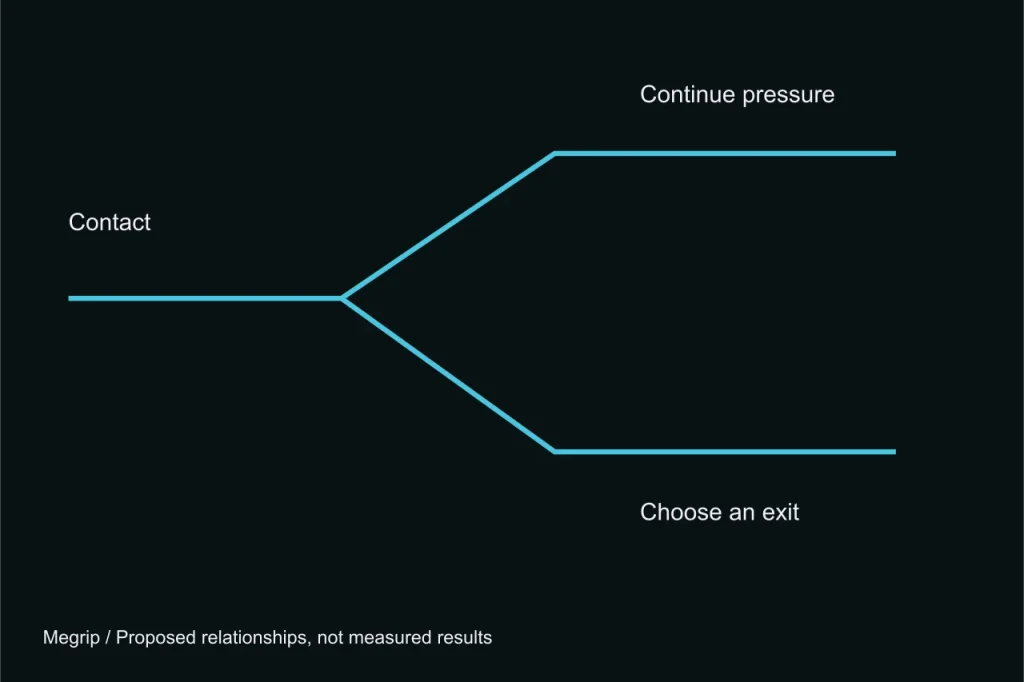
A long combo can look expressive while offering only one sensible input: continue. For Heatbreak, that would waste the most interesting moment in a hydraulic exchange. A successful strike should create a decision about pressure, position and heat. The pilot may take the cannon opportunity, choose a shorter follow-up or end the sequence. Those alternatives need different consequences that can be understood before the input, rather than discovered only after the frame is trapped in recovery.
FRAME 01 An opening is not an obligation
The first design question is what a clean hit actually provides. It might change the opponent’s posture, move it into a line of fire or create a brief interval without an immediate counterattack. None of those conditions should automatically imply that every follow-up is safe. Another threat can still occupy the arena. A useful chain communicates the opportunity while preserving that wider context. The player should feel responsible for extending the exchange, not merely rewarded for completing a predetermined series of prompts.
FRAME 02 Show the point where the machine commits
An animation can communicate a boundary through the frame’s support and alignment. Before the torso locks into a cannon stance, a shorter recovery may still be available. After the lock, the pilot must accept a more limited set of actions. The exact timing remains a prototype question, but the principle is clear: the visible movement and the control rules should agree. A frame that appears free to move while the input is silently ignored makes the chain feel unreliable rather than heavy.
FRAME 03 A stop should produce a position
Ending a sequence is not interesting if it simply returns the frame to an identical neutral pose regardless of context. A short finish could leave the pilot angled toward an exit, while a forceful finish might create more distance but require a longer reset. These outcomes connect the move list to the arena. The cannon recovery study develops this idea further. Recovery is not only an amount of time; it is a relationship to cover, opponents and the direction of the next useful movement.
FRAME 04 Heat changes the value of continuation
A sequence that is sensible with a cool reactor may become costly after repeated pressure. The feedback must explain why. We would avoid a hidden threshold that unexpectedly disables the next input. Instead, the machine should indicate its thermal condition and the consequences associated with an extension. This does not require every action to display a numerical cost. Stable vent behaviour, a clearly divided gauge and consistent control responses can support a practical understanding, provided they remain legible when the combat scene is busy.
FRAME 05 Keep input assistance separate from automatic decisions
Input buffering can make a deliberate follow-up reliable without choosing it for the player. The interface should distinguish a queued action from an action that has already begun. A generous buffer is not necessarily helpful if it causes an old input to execute after the player has decided to stop. The proposed prototype would need to examine that boundary with different input methods. No results are claimed here. The question is whether a player can intentionally end a chain as reliably as they can extend it.
FRAME 06 Begin with one meaningful branch
A small trial could use one opening strike, one cannon continuation and one short exit. That is enough to ask whether the alternatives change the player’s reasoning. Adding many branches before this relationship works would increase complexity without demonstrating depth. The Frame Trials place the chain within Heatbreak’s broader thermal loop. The desired result is an exchange whose ending belongs to the pilot: a choice made from readable conditions, not an animation that simply runs out of steps.