
FRAME DOSSIER / CONCEPT
Heatbreak
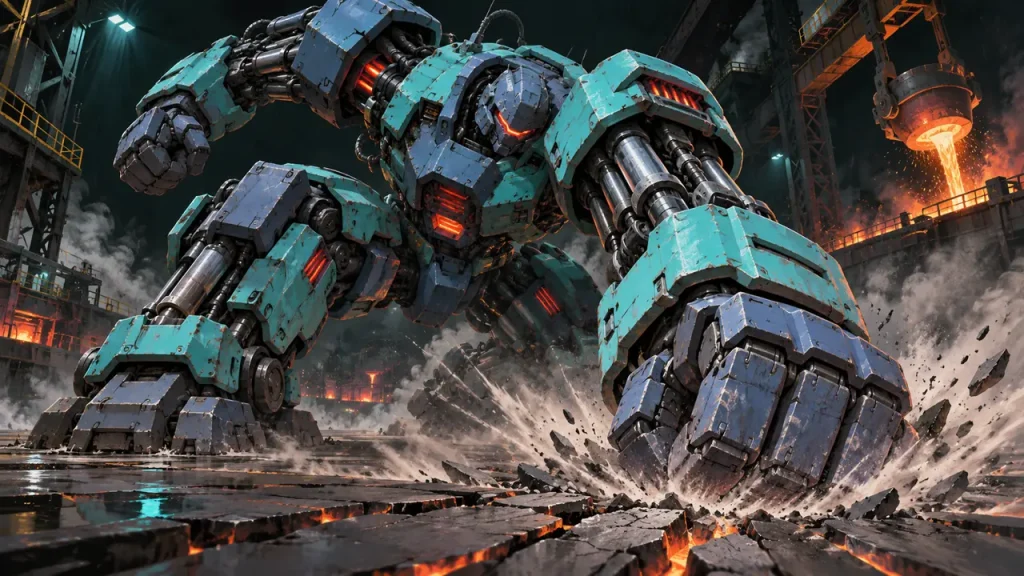
Heatbreak is a proposed mech-action game about extending pressure without losing control of the next exchange. The pilot drives a hydraulic frame through short punch sequences and chooses when to convert an opening into cannon fire. Every extension changes the machine’s thermal situation. The central question is not whether another attack is available, but whether the position after it will still be useful.
Approach with a recovery in mind
The intended loop begins before the first hit. Read an opposing frame’s posture, enter at a distance that leaves an exit and choose a strike whose recovery suits the available space. A clean connection creates a brief opportunity, but it does not suspend the rest of the arena. Another threat may still be moving. The player should be able to recognise that context without rotating the camera wildly or relying on an offscreen warning that arrives too late.
Convert hydraulic force into a cannon window
A punch changes the opponent’s position and posture. A cannon follow-up uses that change, but has a different commitment. Its preparation and recovery should be visible in the frame’s stance and weapon alignment. The pilot can decline the shot even after earning the opening. This makes a successful strike a decision point rather than the first step in a mandatory combo. The chain design note examines why a sensible stopping point matters as much as an exciting extension.
Reactor heat changes the shape of pressure
Heat is intended as a relationship among actions, not merely a red bar to avoid. A long exchange can reduce comfortable follow-up options and make a cooler route through the arena valuable. The machine should communicate that change through stable indicators, vent behaviour and clearly explained control consequences. We do not propose random input failure as a substitute for overheating. The player needs to know which options remain dependable. The heat feedback study explores that requirement.
The foundry as a combat diagram
The concept’s initial setting is a decommissioned casting hall with broad lanes, heavy supports and furnace channels. These features organise approach and retreat. A pillar can interrupt a line of fire, while a narrow maintenance bridge makes a long recovery more dangerous. The environment should remain readable when effects are reduced. Its function is to shape the exchange, not to overwhelm the player with an industrial spectacle unrelated to the controls.
Weight without unreadable motion
The art direction uses cyan armor, slate machinery and restrained red heat indications against a dark foundry. Piston travel and foot placement should explain force. Camera movement can reinforce contact, but players should be able to reduce shake without losing information. Input buffering and remapping deserve attention early, because the intended difficulty is choosing a commitment at the right moment rather than discovering an obscure timing window through repeated frustration.
A narrow first demonstration
Heatbreak remains at concept stage. A useful first prototype would contain one short hydraulic chain, one cannon follow-up and a thermal system with a small number of clearly described consequences. It would ask whether players can explain why they stopped or continued an exchange. We have not announced a playable build, release date or store destination. The project should earn additional moves only after its simplest pressure-and-recovery relationship can be understood in motion.