
Cannon Recovery Is a Position
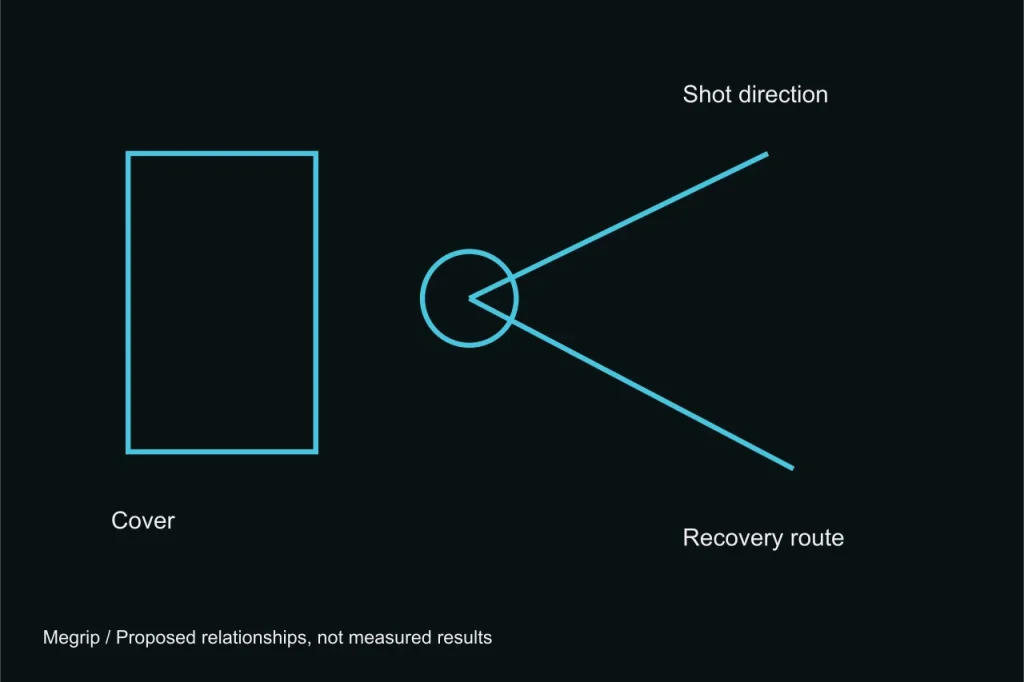
A cannon can be balanced by a long recovery timer and still feel arbitrary. If the frame’s pose, location and available actions do not explain the delay, the player experiences a pause rather than weight. In Heatbreak, we want the recovery to be a position in the fight. Firing should leave the machine somewhere specific, facing a useful or dangerous direction, with a readable route back into movement. The duration matters, but it is only one part of the decision.
FRAME 01 Preparation tells the pilot what is being traded
Before the shot, the frame may align its torso and settle its support. That movement can make the commitment visible. It should also communicate what is being surrendered: perhaps a quick change of direction or the ability to answer an approaching threat immediately. The design must not imply total immobility if some movement remains available. A clear preparation phase gives the player a chance to judge the shot against the arena, rather than treating the cannon as a button whose hidden cost arrives afterwards.
FRAME 02 Recoil needs a consistent relationship to space
The shot’s effect on the frame should be understandable across repeated uses. It might alter stance or require a visible mechanical reset, but it should not randomly place the pilot in a worse position to manufacture difficulty. Consistency lets players plan around a support, a corner or an open lane. The environment can then create different outcomes from the same move without changing its basic rules. A narrow passage is dangerous because of the space it leaves, not because the game secretly lengthens recovery inside it.
FRAME 03 Facing can matter without fighting the camera
A heavy weapon’s alignment can make direction important. However, forcing the camera into a dramatic angle may hide the threat that makes the direction meaningful. The proposed approach keeps the tactical view readable while the frame performs its physical reset. Optional cinematic emphasis should not remove information. A player who reduces shake or motion should receive the same account of where the machine stands and which side is exposed. Otherwise presentation settings become an unintended difficulty setting rather than a comfort choice.
FRAME 04 A follow-up opportunity can still be declined
The existence of a cannon window after a punch should not make firing mandatory. If the shot leaves the frame facing away from its safest exit, the pilot may choose a shorter finish. The chain study examines how to make that choice reliable. The recovery concept gives it a concrete consequence. Declining damage can preserve a better next position, which is a more interesting trade than simply waiting for a meter to become available again.
FRAME 05 Compare with a planted stance
Anchor Fist offers a related but distinct commitment. Its brace ties force to support and makes release part of the action. A cannon recovery and a brace release should not become identical animations with different names. One follows the weapon’s alignment and reset; the other follows the frame’s relationship with the ground. Comparing them helps identify whether each project has a genuine tactical question or merely a different visual theme around the same control loop.
FRAME 06 Prototype the bad position as well as the good one
A first trial should include an obvious safe shot and an understandable risky shot. The goal is not to catch players with a hidden counterattack. It is to see whether the difference can be recognised before firing and explained afterwards. We have no published results for that trial. The concept remains a proposal for a small, readable combat system. If the recovery is understood only as an arbitrary wait, adding more weapons will not solve the underlying problem. The machine’s next position must become part of the action the player chooses.