
Heat Must Explain the Next Choice
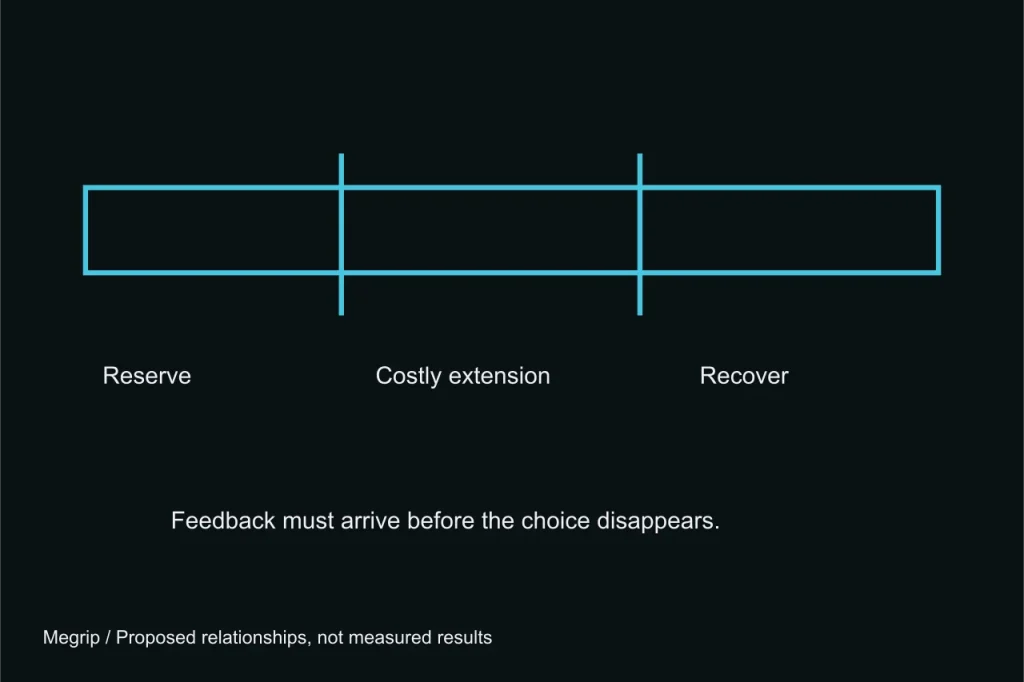
A heat meter can become a second ammunition counter: attack until it fills, wait until it empties, repeat. That is easy to communicate but may add little to a mech fight. Heatbreak instead treats thermal pressure as a way to change the value of continuing an exchange. The design challenge is to make those changes predictable. A pilot should recognise a costly follow-up before committing, rather than learn about the reactor only when a warning interrupts an otherwise successful sequence.
FRAME 01 Describe consequences before choosing a scale
The first question is not how many units of heat a punch creates. It is what a warmer frame does differently in a way the player can understand. A proposed consequence might affect the comfortable length of a follow-up or the value of a recovery route. Whatever the choice, it needs to be consistent and visible. Numerical tuning comes later. A beautifully animated meter cannot rescue a system whose relationship to the controls remains vague or changes without explanation from one encounter to another.
FRAME 02 Give thresholds a stable language
If the design uses thermal bands, each band should mean something specific. Their boundaries need more than a colour shift that disappears under effects or becomes difficult to distinguish for some players. Labels, shapes and repeatable frame behaviour can reinforce the distinction. A warning should arrive while there is still a useful alternative, such as ending a chain or choosing a route with room to recover. An alert delivered only after control options collapse reports a failure; it does not support a decision.
FRAME 03 Do not punish the act of reading
The pilot needs enough time to interpret feedback without losing the entire exchange merely for looking at the interface. Important thermal information should remain near the visual action or be reflected in the frame itself. A quiet training context can establish the relationship before several threats compete for attention. The design should also distinguish heat generated by a deliberate action from heat that changes for another visible reason. An unexplained increase makes careful observation feel pointless, especially when the player is trying to understand a first encounter.
FRAME 04 Cooling should have spatial meaning
Waiting in place is only one possible response to a hot reactor. Repositioning behind a support, ending pressure at a safer distance or declining a cannon opportunity can create more varied decisions. The environment then matters without needing special cooling zones pasted onto every arena. The chain exit note connects this to move design: a useful stopping point can preserve a recovery route. The pilot should be able to recognise that route before the exchange reaches its most expensive moment.
FRAME 05 Separate feedback from spectacle
Red vents and a changing reactor sound can contribute to the machine’s character, but they should not be the only sources of information. Reduced effects, lower volume and a less forceful camera should preserve the same tactical facts. We would test a plain presentation first, then add the more dramatic layer while checking that it does not obscure the signal. This is a proposed method, not a published accessibility result or a claim that every option is already implemented.
FRAME 06 Ask what the pilot can explain
An initial thermal prototype should be judged by a practical question: can a player explain why one continuation was sensible and another was costly? That explanation matters more than a polished temperature animation. If the answer depends on memorising an invisible rule, the feedback or the rule needs revision. The Workshop describes how combat, animation and interface responsibilities meet here. Heatbreak remains a concept, and the public writing should keep the distinction between an intended relationship and a demonstrated result clear.