
The Ground Needs a Readable Answer
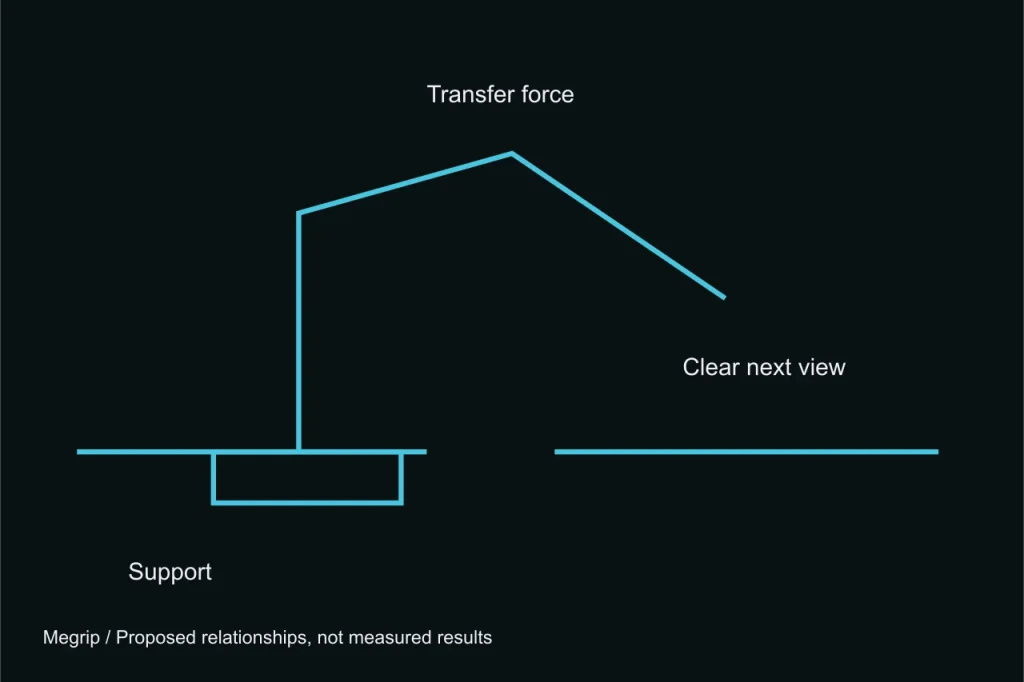
A heavy mech landing on a platform should make the ground feel present. Dust, debris and camera movement can achieve that impression quickly, but they can also hide the result of the action. Anchor Fist needs a more precise answer from the terrain. The pilot must understand whether the stance is supported, where the impact moved another frame and which route remains available. Effects should help describe those facts rather than temporarily replacing the arena with a cloud.
FRAME 01 Establish support before the impact
A broad anchor plate, a fractured edge and a narrow ledge should look different for reasons that matter to the proposed brace. The player needs to read those differences while approaching. A small texture change that becomes visible only under the mech’s feet is too late. Large silhouettes, structural seams and the relationship to nearby supports offer more useful cues. The first arena should contain a limited set of clearly differentiated surfaces rather than many ambiguous materials that require memorising a hidden compatibility table.
FRAME 02 Let the frame show the load
Foot placement and hydraulic compression can communicate that the brace has engaged. This is more informative than a generic glow beneath the machine. A visible connection between stance and support helps the player understand why an action differs from an unbraced strike. It also gives release a physical explanation. The frame must regain a mobile posture rather than simply waiting for an icon to turn off. The exact animation remains to be developed, but its informational purpose should be defined before the spectacle is added.
FRAME 03 Separate a mark from a new obstacle
An impact mark can show where force was delivered without changing the arena’s navigation. If some impacts do create obstacles or alter support, that difference needs a stable visual language. Otherwise players cannot tell whether a broken-looking patch is decoration or a new rule. The concept does not promise unrestricted destruction. A small number of purposeful terrain responses would be easier to understand and more useful to the core stance decision than a large amount of debris with inconsistent consequences.
FRAME 04 Keep the next threat visible
Dust should not erase the opponent’s posture at the moment the pilot needs to choose a release. A restrained effect can travel away from the important silhouettes or fade quickly around them. Reduced-particle settings should preserve contact feedback through sound, animation and clear marks, with visual equivalents for essential audio cues. The goal is not to remove the feeling of impact. It is to ensure that the forceful moment still belongs to a readable exchange rather than becoming a brief interruption of play.
FRAME 05 Use terrain to vary a known action
The same brace can create different tactical outcomes on a broad terrace and beside a narrow exit. This variation should arise from visible space, not from secretly changing the move’s timing. The recovery note develops a parallel argument for Heatbreak. A consistent action becomes interesting when the surrounding position changes. For Anchor Fist, the support and the route out of the stance are the primary relationships to examine before adding more attack variants.
FRAME 06 A first arena should answer a small question
One proving-ground terrace could contain a dependable plate, a clearly unsuitable edge and two possible exits. That would be enough to ask whether players can select a brace location for an understandable reason. We have not run or published that proposed test. The public art is a concept direction, not evidence of a complete terrain system. The Frame Trials place the idea within the two projects. The useful outcome is a pilot who can say what held the frame, what changed at contact and why the next movement remained possible.